

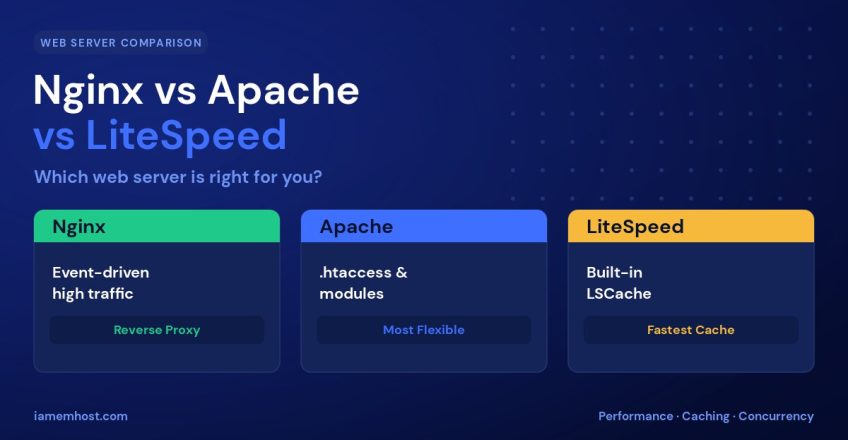

The web server is the software that sits between your site’s files and every visitor’s browser, and the one you choose has a real impact on speed, resource usage, and how much tuning you’ll do. Three names dominate: Apache, the veteran; Nginx, the high-concurrency favourite; and LiteSpeed, the performance-focused commercial option. This guide compares them on architecture, performance, features, and cost so you can pick the right one for your site.
The Core Architectural Difference
The biggest distinction is how each server handles concurrent connections:
- Apache traditionally uses a process/thread per connection (the
preforkorworkerMPM). Simple and flexible, but memory use climbs under heavy concurrency. - Nginx uses an asynchronous, event-driven model — a small number of worker processes handle thousands of connections each. This is why it excels at high traffic and static content.
- LiteSpeed is also event-driven like Nginx, but adds an Apache-compatible layer and aggressive built-in caching.
Side-by-Side Comparison
| Feature | Apache | Nginx | LiteSpeed |
|---|---|---|---|
| Architecture | Process/thread per request | Event-driven | Event-driven |
| Static file speed | Good | Excellent | Excellent |
| High concurrency | Moderate | Excellent | Excellent |
.htaccess support | Yes (native) | No | Yes (Apache-compatible) |
| Built-in cache | Via modules | FastCGI cache (manual) | LSCache (built-in) |
| HTTP/3 (QUIC) | Limited | Yes | Yes |
| Licensing | Free / open source | Free / open source | Commercial (OpenLiteSpeed is free) |
| Config style | Flexible, verbose | Clean, centralised | GUI + Apache-style |
Where Apache Still Shines
Apache’s .htaccess file lets you change rewrite rules, redirects, and access controls per-directory without restarting the server — invaluable on shared hosting where users can’t touch the main config. Its enormous module ecosystem and decades of documentation make it the safest default when compatibility matters more than raw throughput.
Where Nginx Wins
For serving static files, acting as a reverse proxy, or handling thousands of simultaneous connections on limited RAM, Nginx is hard to beat. It’s the standard front-end for high-traffic sites and is frequently placed in front of Apache or an app server. A typical PHP setup pairs Nginx with PHP-FPM:
location ~ \.php$ {
    fastcgi_pass   unix:/run/php/php8.2-fpm.sock;
    fastcgi_index  index.php;
    include        fastcgi_params;
}
Where LiteSpeed Wins
LiteSpeed reads Apache’s configuration and .htaccess directly, so it can often drop in as a faster Apache replacement. Its killer feature for WordPress, Magento, and Joomla sites is LSCache — a built-in, full-page cache that’s tightly integrated with the official plugin and typically delivers the best out-of-the-box performance of the three. The trade-off is licensing cost (the free OpenLiteSpeed lacks some enterprise features and per-directory config flexibility).
Which Should You Choose?
| Your situation | Best choice |
|---|---|
Shared hosting, need .htaccess | Apache or LiteSpeed |
| High-traffic static site or reverse proxy | Nginx |
| WordPress/WooCommerce, want fastest cache with least effort | LiteSpeed (LSCache) |
| Maximum control on a tight RAM budget | Nginx |
| Legacy app expecting Apache modules | Apache |
Conclusion
There’s no single “best” web server — only the best fit for your workload. Choose Apache for compatibility and .htaccess flexibility, Nginx for raw concurrency and as a reverse proxy, and LiteSpeed when you want Apache compatibility plus the easiest path to top-tier caching performance. Many high-performance stacks even combine them — Nginx in front, Apache or PHP-FPM behind — to get the best of both.