

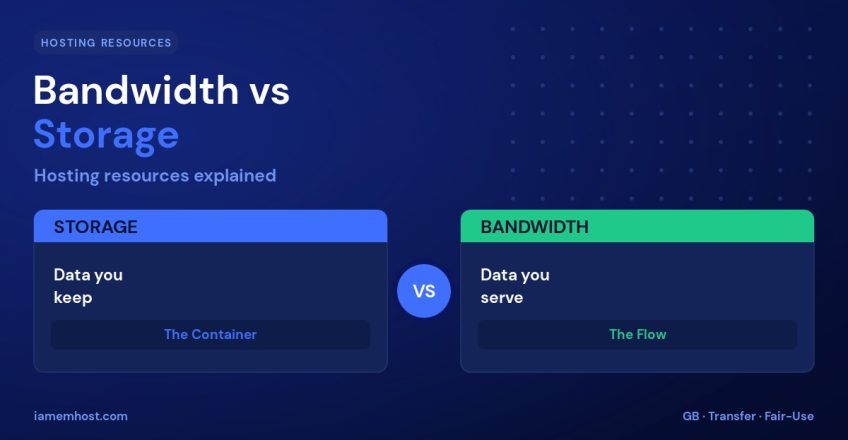

When you compare hosting plans, two resources dominate the spec sheet: bandwidth and storage. They’re often confused, but they measure completely different things — and understanding the difference helps you pick a plan that fits without overpaying. This guide explains what each one is, how much you actually need, and what those tempting “unlimited” labels really mean.
Storage: How Much You Can Keep
Storage (or disk space) is the total amount of data your hosting account can hold — your website files, images, videos, databases, and email. It’s measured in gigabytes (GB). Think of it like the size of a hard drive: the more content you have, the more storage you need.
Bandwidth: How Much You Can Serve
Bandwidth (or data transfer) is the amount of data sent between your site and its visitors over a period — usually per month. Every time someone loads a page, downloads a file, or watches a video, that data counts toward your bandwidth. Think of it like water flowing through a pipe: the more visitors and the heavier your pages, the more bandwidth you use.
Storage vs Bandwidth Side by Side
| Storage | Bandwidth | |
|---|---|---|
| Measures | Data you keep | Data you transfer |
| Analogy | Size of the container | Flow through the pipe |
| Grows with | Content & files | Traffic & page weight |
| Unit | GB | GB / month |
| Runs out when | Disk is full | Monthly limit is hit |
A Simple Way to Estimate Bandwidth
You can roughly estimate monthly bandwidth with one formula:
Monthly bandwidth ≈ Average page size × Page views per month × Safety factor (1.5)

Example: 2 MB per page × 50,000 views × 1.5 = ~150 GB / month
The safety factor covers repeat visits, crawlers, and downloads. If your site is media-heavy, your page size — and therefore bandwidth — climbs quickly.
What “Unlimited” Really Means
Many shared plans advertise “unlimited” storage or bandwidth. In practice this means unmetered — you won’t be charged per GB — but usage is still governed by a fair-use policy and by other resource limits like CPU, memory, and inode (file) counts. A normal website will never hit a wall, but you can’t run a massive file-sharing service on an “unlimited” shared plan. Always read the acceptable-use policy.
How Much Do You Actually Need?
- Small blog / brochure site — a few GB of storage and modest bandwidth is plenty.
- Growing business site — more storage for images and a comfortable bandwidth buffer.
- Online store — more of both, plus headroom for traffic spikes and product media.
- Media / video site — high on both; a CDN helps offload bandwidth.
Tip: a CDN caches your assets externally, dramatically reducing the bandwidth used from your own account.
Conclusion
Storage is how much you can keep; bandwidth is how much you can serve. Most sites need modest storage and enough bandwidth to cover their traffic with room to spare. Estimate your needs, treat “unlimited” as “unmetered within fair use,” and lean on a CDN if your bandwidth climbs. Choose the plan that fits your content and audience — not just the biggest number.

Managed vs Unmanaged Hosting: Which Do You Need?
Iamem Hosting