

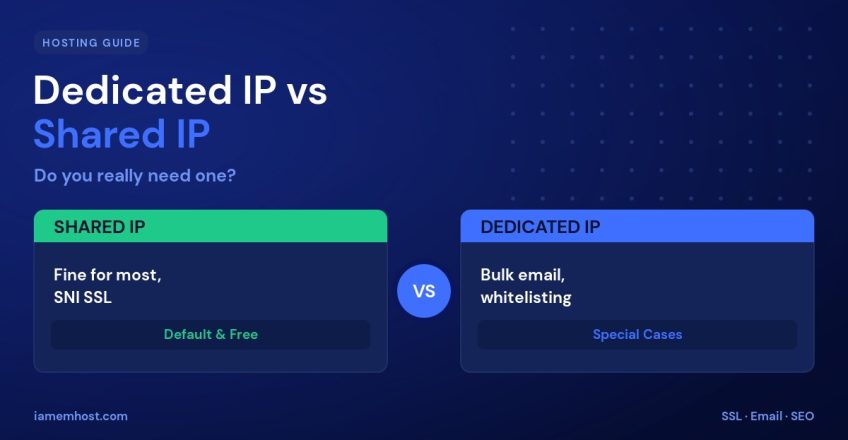

When setting up hosting, you’ll often be offered a dedicated IP address as an add-on. It sounds important — your own IP, just for you — but do you actually need one? For most websites the honest answer is no, though there are specific cases where it genuinely helps. This guide explains the difference between dedicated and shared IPs and when paying for a dedicated one is worth it.
Shared vs Dedicated IP: The Basics
Every server has an IP address. With a shared IP, your website shares that address with other sites on the same server — which is completely normal and how most shared hosting works. With a dedicated IP, your account has an IP address used by your sites alone.
Thanks to a technology called SNI (Server Name Indication), multiple sites can share one IP and each still serve its own SSL certificate correctly — which is why shared IPs work fine for the vast majority of sites today.
Common Myths
| Claim | Reality |
|---|---|
| “A dedicated IP boosts SEO” | Myth — Google doesn’t rank sites higher for having one |
| “You need one for SSL” | Outdated — SNI lets shared IPs serve SSL fine |
| “Shared IPs are insecure” | Myth — sites are isolated at the account level |
| “It always improves email delivery” | Only if you properly warm and manage it |
When a Dedicated IP Actually Helps
There are legitimate use cases where a dedicated IP is worthwhile:
- High-volume email sending — a dedicated IP gives you full control over your sending reputation, so you’re not affected by a “noisy neighbor” who spams. (It must be warmed up properly.)
- Accessing your site by IP — useful for testing before DNS propagates, or for certain server setups.
- Specific applications — some software, APIs, or payment gateways require a whitelisted, stable IP.
- Compliance requirements — occasionally mandated by security or regulatory policies.
When You Don’t Need One
If you run a typical website — a blog, business site, portfolio, or standard online store — and you send normal volumes of transactional email, a shared IP is perfectly fine. You’ll get valid SSL, good performance, and no SEO penalty. Paying extra for a dedicated IP simply won’t give you a benefit you’ll notice.
The Email Reputation Nuance
The one area worth thinking hard about is email. On a shared IP, your deliverability depends partly on your neighbors’ behavior. A dedicated IP isolates your reputation — but it’s a double-edged sword: a brand-new dedicated IP has no reputation and must be “warmed up” by gradually increasing volume. For most senders, using a reputable SMTP relay is easier and more effective than managing a dedicated IP yourself.
Conclusion
For most websites, a shared IP is all you need — it delivers SSL, performance, and rankings just as well as a dedicated one, and the old myths no longer hold. Consider a dedicated IP only for genuine reasons: high-volume email, IP whitelisting, specific applications, or compliance. When in doubt, save your money and start shared — you can always add one later if a real need appears.

What Is a DDoS Attack? How to Protect Your Website
Iamem Hosting