


When your website outgrows shared hosting, the next question is usually: VPS or dedicated server? Both give you far more power and control than shared hosting, but they differ significantly in cost, performance, and how resources are allocated. This guide compares VPS and dedicated servers head to head so you can pick the right home for a growing site.
The Fundamental Difference
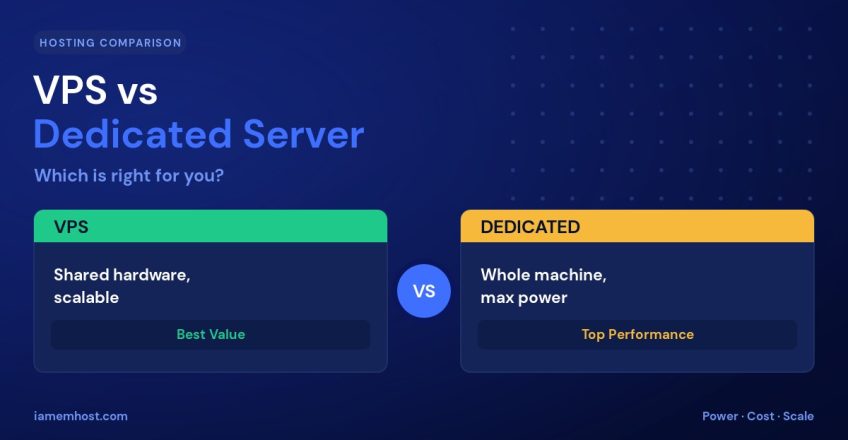
A VPS (Virtual Private Server) is a virtualized slice of a physical server. You get guaranteed, dedicated resources — CPU, RAM, storage — and full root access, but you share the underlying hardware with other isolated VPS instances. A dedicated server is an entire physical machine that’s yours alone. Nothing is shared: all the hardware, all the time.
Side-by-Side Comparison
| Factor | VPS | Dedicated Server |
|---|---|---|
| Resources | Guaranteed slice of a server | Entire physical machine |
| Performance | Excellent for most sites | Maximum, consistent |
| Cost | Mid-range | Highest |
| Scalability | Fast — resize in minutes | Slower — hardware change |
| Control | Full root access | Full root + hardware control |
| Best for | Growing sites & apps | High-traffic, resource-heavy sites |
When a VPS Is the Right Choice
For the large majority of sites that have outgrown shared hosting, a VPS is the sweet spot. Choose it when:
- You need more power and control than shared hosting but not a whole server.
- You want easy scalability — add RAM or CPU in minutes as you grow.
- You’re running a busy WordPress site, a web app, or multiple smaller sites.
- You want dedicated resources at a reasonable price.
When a Dedicated Server Makes Sense
A dedicated server is the top tier — choose it when:
- You have consistently high traffic or a very resource-intensive application.
- You need maximum, predictable performance with zero neighbors.
- You have strict compliance or security requirements that demand isolated hardware.
- You run heavy workloads — large databases, high-concurrency apps, or big eCommerce.
Don’t Forget Managed vs Unmanaged
Both VPS and dedicated servers come in managed and unmanaged flavors. If you’re not comfortable administering a server, a managed plan — where the provider handles updates, security, and monitoring — is well worth it regardless of which type you pick.
Conclusion
A VPS offers dedicated resources, easy scaling, and great value — the right choice for most growing sites. A dedicated server delivers the maximum, most consistent performance for high-traffic, resource-heavy workloads that need a whole machine. Start with a VPS if you’re unsure; you can always scale up or move to dedicated hardware as your traffic demands it.